
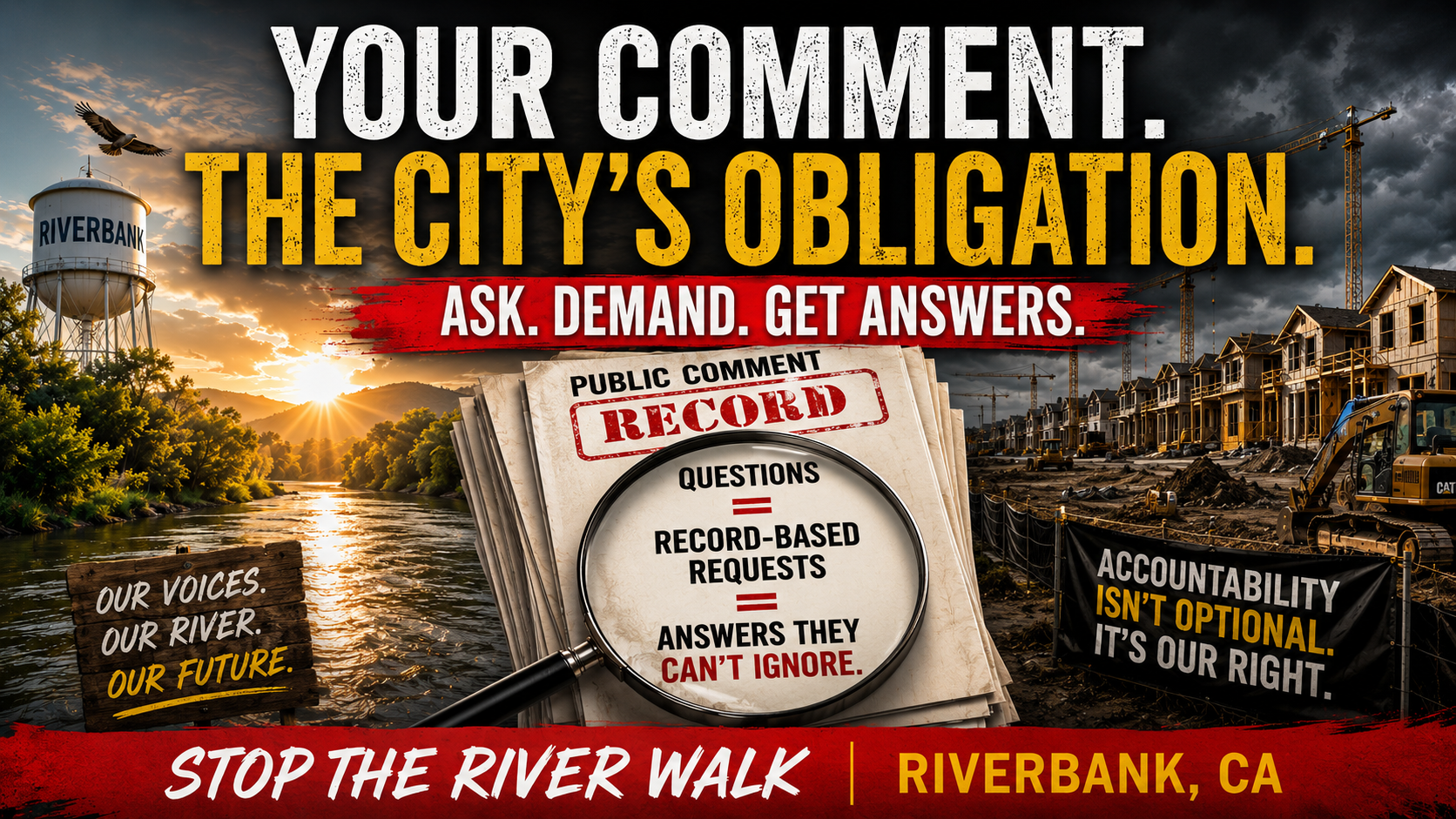
How to submit effective comments the City must answer.
There is a difference between being heard and being entered into the record.
A frustrated question at a meeting may create a moment. A clear, written, evidence-based comment creates a paper trail. And in a fight like River Walk, the paper trail matters.
The proposed River Walk Specific Plan is not a small neighborhood change. The City’s own project page describes a major mixed-use plan near the Stanislaus River, requiring a Sphere of Influence expansion and annexation, with the River Walk Specific Plan covering roughly 997 acres inside a larger approximately 1,522-acre SOI expansion area. The plan includes thousands of residential units, commercial space, infrastructure, parks, open space, and major land-use changes west of Riverbank.
That means public comments cannot be casual.
- They must be sharp.
- They must be specific.
- They must force answers.
Under CEQA, the lead agency must evaluate comments on environmental issues received on a Draft EIR and prepare written responses to comments that raise significant environmental issues. But here is the catch: general opposition is easier to dismiss. A comment that says, “I don’t like this project,” may be emotionally true, but it does not make the City wrestle with the facts.
A record-based comment does.
The rule is simple: Stop Asking Vague Questions
Do not simply ask:
“What about traffic?”
Ask:
“Please identify where the Draft EIR analyzes cumulative traffic impacts from River Walk in combination with existing and approved projects affecting Patterson Road/SR 108, McHenry Avenue, Oakdale Road, and routes used by Riverbank residents. If that analysis is not included, please revise the EIR to include it.”
That is harder to brush aside.
Do not simply ask:
“What about water?”
Ask:
“Please identify the evidence in the record showing the long-term water supply for the full River Walk buildout, including dry-year reliability, groundwater impacts, infrastructure costs, and whether existing Riverbank ratepayers will be responsible for future maintenance.”
That is not a complaint. That is a demand for documentation.
Do not simply ask:
“What about farmland?”
Ask:
“Please identify where the EIR analyzes the loss of agricultural land, the removal of the current Agricultural Resource Conservation designation, and the feasibility of alternatives that avoid or reduce conversion of farmland near the Stanislaus River corridor.”
Now the City has to point to the record, explain the analysis, or expose the gap.
The strongest comment follows this formula
Use this structure:
1. State who you are.
“I am a Riverbank resident.”
“I live near the project area.”
“I drive Patterson Road daily.”
“I farm in Stanislaus County.”
“I am concerned about sewer rates, traffic, habitat, flood risk, and farmland loss.”
2. Identify the document or issue.
“Draft EIR Transportation Section.”
“Water Supply Assessment.”
“Specific Plan land-use map.”
“Biological resources analysis.”
“Infrastructure financing plan.”
3. Ask for a specific record-based answer.
“Please identify where the EIR analyzes…”
“Please provide the data supporting…”
“Please explain whether the City considered…”
“Please revise the EIR to address…”
4. Request mitigation or alternatives.
“Please analyze a reduced-footprint alternative.”
“Please evaluate an alternative that avoids the Stanislaus River corridor.”
“Please require enforceable mitigation before approval.”
“Please disclose who pays for long-term maintenance.”
5. Submit it in writing.
Spoken comments matter. Written comments endure.
The City’s River Walk page previously directed Draft EIR comments to the City and stated that comments on the Draft EIR would be formally addressed in the Final EIR response to comments.
Always check the latest official notice before submitting, but do not wait until the last minute.
Why facts matter more than fury

Anger is understandable. Riverbank residents are looking at traffic, farmland loss, river impacts, sewer costs, air quality, and the possibility that today’s ribbon-cutting becomes tomorrow’s public bill.
But CEQA is built around the record.
California’s CEQA Guidelines define “substantial evidence” as relevant information and reasonable inferences based on that information. Facts, fact-based assumptions, and expert opinion supported by facts count. Pure speculation or unsupported opinion generally does not.
That does not mean ordinary residents are powerless.
It means ordinary residents must be precise.
You do not need to be an attorney. You do not need to write like an engineer. You need to connect your concern to the project, the environment, the document, and the missing answer.
Your lived experience can matter when it points to a real impact.
“I sit through traffic every weekday at this intersection” is stronger when paired with: “Please compare the traffic model assumptions to current observed peak-hour congestion and disclose whether the model accounts for Costco-area growth, Crossroads traffic, school traffic, emergency access, and River Walk buildout.”
That is how a concern becomes a record.
Turn these common questions into powerful comments
Instead of: “Won’t this ruin traffic?”
Submit: “Please identify the traffic study assumptions for full buildout of 2,432 to 2,682 residential units and up to 875,000 square feet of mixed-use development, and explain whether the analysis includes cumulative impacts from other approved or reasonably foreseeable projects.”
Instead of: “Who pays for sewer?”
Submit: “Please disclose all projected sewer, water, stormwater, road, police, fire, park, and maintenance costs associated with River Walk, and identify which costs are developer-funded and which may become the responsibility of future residents or existing Riverbank ratepayers.”
Instead of: “Is this already decided?”
Submit: “Please confirm that no irreversible project commitments, infrastructure commitments, development agreements, or financing obligations will be approved before completion of legally adequate environmental review and public response.”
Instead of: “Why build near the river?”
Submit: “Please explain why the City selected a project area near the Stanislaus River corridor and floodplain instead of a reduced-footprint or alternate-location plan that avoids sensitive river-adjacent land.”
Instead of: “What about wildlife?”
Submit: “Please identify all biological surveys, seasonal survey dates, species evaluated, habitat impacts, riparian buffers, and enforceable mitigation measures for impacts to the Stanislaus River corridor.”
The third one matters. Because the public process should not be theater after the decision is already written.
Meetings matter, but written comments are the weapon
California’s Brown Act gives the public the right to address local legislative bodies on matters within their jurisdiction at regular meetings, and on agenda items before or during consideration.
Use that right.
Show up. Speak clearly. Bring neighbors. Make the room feel the weight of public opposition.
But do not stop there.
A three-minute speech can disappear into the air. A written comment goes into the record. A written comment can be quoted. A written comment can force a response. A written comment can reveal whether the City has evidence—or only assurances.
So speak, then submit.
Say it at the podium. Send it by email. Attach supporting documents. Ask for confirmation of receipt. Save a copy.
The record is not built by outrage alone. It is built by repetition, precision, and pressure.
The comment that officials fear most
I oppose approval of the River Walk project unless and until the City provides full, evidence-based responses to the environmental, infrastructure, traffic, farmland, water, sewer, flood-risk, public-safety, and fiscal impacts raised by the public.
Please identify the specific pages, studies, models, assumptions, and mitigation measures in the record that support the City’s conclusions. If the record does not contain that evidence, please revise and recirculate the environmental document as required, analyze feasible alternatives, and delay approval until the public has a meaningful opportunity to review the new information.
That is not noise. That is a challenge.
The City does not get to grade its own homework in silence
River Walk is not just a development proposal. It is a test of whether public process means something in Riverbank.
The project area is described by the City as west of Riverbank, north of Patterson Road/SR 108, east of McHenry Avenue, and near the Stanislaus River. Stop the River Walk has warned that the proposal threatens agricultural land, riparian habitat, traffic conditions, air quality, and future sewer costs.
Those concerns deserve more than polished renderings.
They deserve answers.

Not slogans.
Not “trust us.”
Not “growth is inevitable.”
Not “we will study that later.”
Answers.
The record is where those answers must live.
So let every comment ask the same basic question in a hundred different ways:
Where is the evidence?
- Where is the evidence that traffic will not get worse?
- Where is the evidence that water is secure?
- Where is the evidence that farmland loss is unavoidable?
- Where is the evidence that sewer costs will not fall on residents?
- Where is the evidence that the river corridor will be protected?
- Where is the evidence that alternatives were honestly considered?

And if the evidence is missing, say so.
Loudly.
In writing.
On the record.
Final call: don’t just oppose River Walk. Document it.
The most powerful public comment is not the angriest one.
It is the one they have to answer.
So here is the assignment:
Read one section. Ask one precise question. Submit one written comment. Get one neighbor to do the same.
Then repeat.
A project this large should not move forward on vague promises and glossy language. It should have to survive the full weight of public scrutiny.
Because once farmland is paved, it does not grow back.
Once the river corridor is compromised, it does not heal on command.
Once infrastructure costs are shifted, residents pay for decades.
And once the City expands its boundary, Riverbank becomes something different.
Make them prove this project is worth that cost.
Make them answer.
Make the record impossible to ignore.
